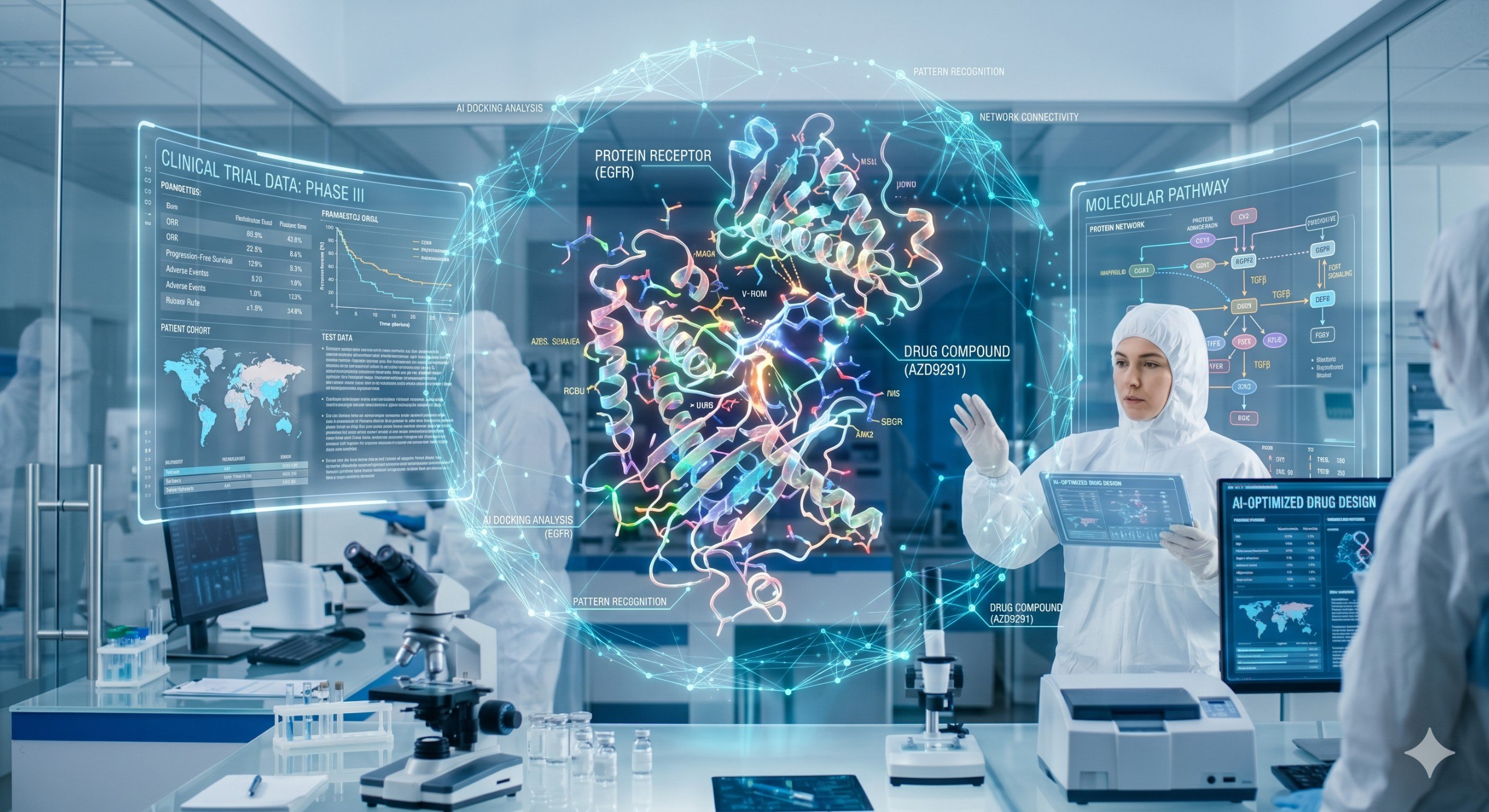
2026 marks the critical inflection point for AI-driven drug discovery — transitioning from proof of concept to industrialization. As of mid-2026, over 173 AI-originated drug programs have entered clinical development globally, with 15-20 expected to enter pivotal trials this year. AI-discovered molecules demonstrate 80-90% Phase I success rates, far exceeding the historical average of ~52%. Industry consensus projects the first fully AI-discovered and designed drug to receive FDA approval in 2026-2027 — a watershed moment for pharmaceutical R&D.
The structural foundation of this wave rests on three years of cumulative technological progress. AlphaFold2 solved protein structure prediction in 2021. Generative AI automated molecular design in 2023-2024. The critical 2025-2026 advance has been end-to-end integration — complete AI pipelines spanning target discovery, molecular generation, ADMET prediction, and clinical trial design.
Two companies exemplify the different architectural approaches in AI drug discovery.
Insilico Medicine achieved end-to-end AI drug discovery with ISM001-055, taking a fibrosis drug from target discovery to Phase I in just 30 months — compared to the industry average of 3-6 years. The company's Pharma.AI platform integrates three core components: PandaOmics (target discovery), Chemistry42 (small molecule generation), and inClinico (clinical trial prediction), creating a complete digital chain from biological hypothesis to clinical protocol. ISM001-055 is currently in Phase II for idiopathic pulmonary fibrosis.
Recursion Pharmaceuticals follows a different technical path. Its Recursion OS platform is built on high-throughput phenotypic screening, generating over 2 million cellular microscopy images daily. Computer vision and machine learning analyze drug effects on cellular systems. Recursion has established a closed loop between wet lab and dry lab — experimental results feed back into AI models, continuously improving target prediction accuracy.
By therapeutic area, oncology remains the largest AI drug target domain (~40%), followed by CNS disorders (~20%), inflammation and autoimmune diseases (~15%), and fibrosis (~10%). Notably, rare disease AI programs are increasing — AI's predictive capability in data-scarce conditions makes it particularly suitable for rare disease drug development.
AI's role in drug discovery has also deepened. Early applications focused on lead optimization — predicting molecular properties and biological activity. AI now extends to:
Target discovery: Integrating genomics, proteomics, and clinical data to identify novel drug targets from massive heterogeneous datasets.
Clinical trial design: AI simulates trials, optimizes patient stratification, and predicts adverse events. Studies show AI-optimized trial design can reduce clinical trial duration by 30-50% while reducing failure risk.
Biologic design: Generative AI has expanded from small molecules to antibodies, enzymes, and peptides. AI designs antibody sequences with specific binding properties and low immunogenicity.
However, AI drug discovery faces several critical bottlenecks.
The "valley of death" in clinical validation is the core challenge. While Phase I success rates are impressive (80-90%), Phase II failure rates remain high — a structural challenge for the entire pharmaceutical industry, not unique to AI. AI can produce better candidates at the molecular design stage but cannot eliminate biological complexity. No AI-discovered drug has yet completed Phase III and received FDA approval, meaning AI's ultimate validation moment has not arrived.
Data quality and accessibility remain persistent constraints. AI model performance depends heavily on training data quality and diversity. Clinical data, electronic health records, and real-world evidence access remain limited, particularly in Asian markets where healthcare data standardization lags behind the US and Europe.
Industry economics favor AI adoption. Traditional drug development averages 10-15 years and $2.5+ billion per approved drug. McKinsey estimates generative AI could save $60-110 billion annually across the pharmaceutical value chain. AI's ability to compress discovery timelines by 30-50% is particularly valuable for underserved areas such as neurodegenerative diseases, rare diseases, and drug-resistant infections.
From a global perspective, AI drug discovery is diversifying geographically. The US still dominates (~60% of startups), but China is catching up rapidly — over 30 Chinese AI drug discovery startups with ~40 clinical pipeline projects. The UK and Switzerland leverage traditional pharmaceutical strength for significant presence. This geographic diversity provides a foundation for cross-border collaboration — AI model training requires diverse human genomic data, and population genetic differences must be considered in drug development.
Three events merit close attention in H2 2026: Insilico's ISM001-055 Phase II IPF interim results, Recursion-Roche collaboration clinical progress, and the possibility of the first AI-discovered drug NDA submission to FDA. If these milestones are met, AI drug discovery will upgrade from "promising new approach" to "standard industry tool."
Disclaimer: This article is for informational purposes only and does not constitute investment advice. Data and time-sensitive information are current as of the publication date and subject to change. Neither the author nor POC.HK assumes responsibility for any losses resulting from the use of this information.