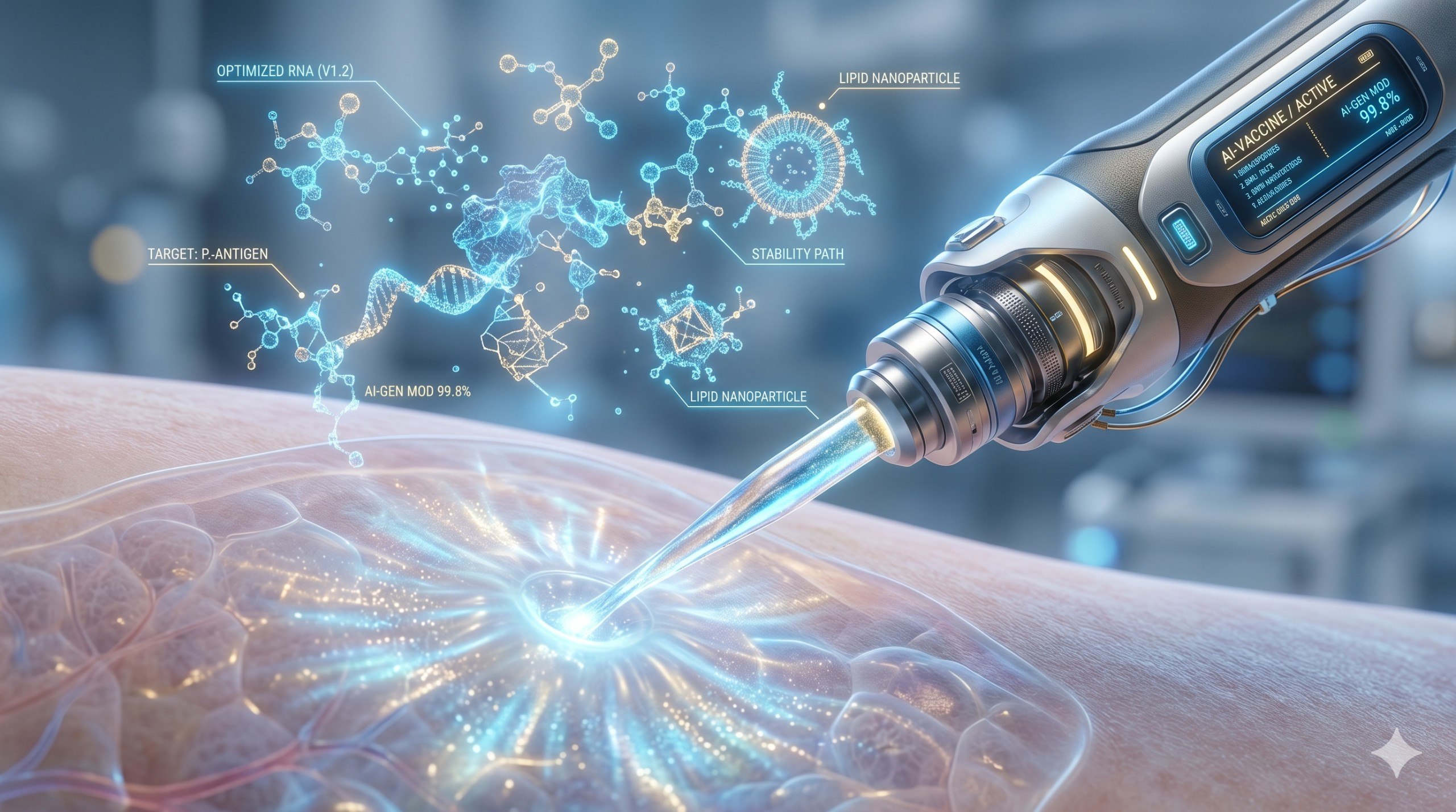
In June 2026, researchers from the University of Cambridge and its spinout DIOSynVax (DVX) published results in the Journal of Infection from the first human clinical trial of a universal coronavirus vaccine whose active component was designed entirely by computer simulation and machine learning. The candidate, pEVAC-PS, demonstrated safety and immune response in 39 healthy volunteers with no serious adverse events.
The significance of this result extends far beyond COVID-19. This is the first time in human history that a vaccine whose active ingredient was designed entirely by computer has been tested in humans and produced positive results — not discovered by chance, not refined through empirical iteration, but designed from scratch using AI analysis of viral genomic data, delivering a "super-antigen" that works in the human body.
From Reactive to Proactive: A Paradigm Shift in Vaccine Development
Traditional vaccine development is fundamentally reactive. When a new virus emerges, scientists must isolate the strain, culture it, inactivate or attenuate it, and test it. This process was dramatically accelerated for SARS-CoV-2 — from genetic sequence publication to authorized vaccine in 11 months — but the underlying logic remains "chasing the virus."
mRNA platforms changed the speed but not the direction. Whether mRNA, adenovirus vector, or recombinant protein, antigen design still relies on empirical selection based on known virus strains. When the virus mutates, vaccines need updating — which is why annual influenza vaccines are needed, and why Omicron required updated COVID-19 vaccines.
DIOSynVax's approach inverts this logic. Rather than selecting any known coronavirus strain as an antigen template, the team used machine learning to analyze global genetic sequence data from the entire Sarbecovirus genus, identifying conserved structural features shared by all members of this virus family. Computer simulation then designed a "super-antigen" containing these shared features — an antigen that does not correspond to any known virus, but serves as a protective shield against the entire viral family.
The core breakthrough: the vaccine targets conserved regions across the entire viral family, including variants that have not yet emerged and unknown viruses that could potentially jump from animals to humans. This gives the vaccine "future-proof" properties.
How the Super-Antigen Works
The pEVAC-PS vaccine operates on three technical levels.
Level 1: Data-driven antigen identification. Machine learning analyzed genomic sequence data from the Sarbecovirus subgenus (including SARS-CoV-1, SARS-CoV-2, and related bat coronaviruses). The computational model identified evolutionarily conserved regions — areas that have remained nearly unchanged over millions of years because they are essential for viral survival and replication — from tens of thousands of viral sequences.
Level 2: Computational antigen design. The AI predicted which conserved regions are most likely to be recognized by the immune system and trigger strong immune responses. Computer simulations optimized the antigen's three-dimensional structure for optimal presentation to B cells and T cells — a process that traditionally relies on trial and error over months, now reduced to days.
Level 3: Needle-free delivery and thermal stability. pEVAC-PS uses the PharmaJet Tropis microfluid injection system for needle-free administration, using fluid dynamics to precisely deliver the vaccine into intradermal tissue. The vaccine itself is thermostable, requiring no cold chain. Together, these two features enable deployment in remote areas and resource-limited settings without trained medical professionals or refrigeration.
Phase 1 Trial Results
The open-label Phase 1 dose-escalation trial was conducted at NIHR Clinical Research Facilities in Southampton and Cambridge, sponsored by University Hospital Southampton NHS Foundation Trust with primary funding from Innovate UK.
Thirty-nine healthy volunteers aged 18-50 were divided into four dose cohorts (0.2 mg, 0.4 mg, 0.8 mg, and 1.2 mg), receiving vaccination on day 0 and day 28. Primary endpoints were safety and reactogenicity.
Results showed no serious adverse events and good tolerability at all dose levels. The vaccine successfully triggered neutralizing antibody responses against multiple coronaviruses — including SARS-CoV-2 and its variants, as well as SARS-CoV-1. Notably, even volunteers with high pre-existing immunity (who had received 2-3 prior COVID-19 vaccine doses) generated additional immune responses.
Phase 2 trials are being planned with approximately 200 volunteers to further evaluate immune efficacy and durability.
Beyond COVID-19: Platform Scalability
DIOSynVax's platform technology extends beyond coronaviruses. The same AI design methodology can be applied to other virus families — influenza, Ebola, hemorrhagic fevers. DIOSynVax already has candidate vaccines in development for seasonal/pandemic influenza and hemorrhagic fever viruses.
This means vaccine development can shift from "chasing every new virus" to "proactively designing protection for entire virus families." In theory, universal vaccines could be prepared for a virus family before the next unknown virus jumps from animals to humans — true pandemic prevention.
From an economic perspective, traditional vaccine development costs $200 million to $1 billion per candidate and takes 10-15 years. AI-designed vaccines could slash both time and cost by orders of magnitude, with profound implications for global health security investment returns.
Regulatory Challenges: Evaluating AI-Designed Vaccines
While pEVAC-PS passed standard Phase 1 safety review, its further development faces a unique regulatory question: how do regulators evaluate a vaccine whose active ingredient was designed by AI — where the developers may not be able to fully explain why the AI selected those specific antigen structures?
This mirrors the "black box" challenge facing AI across drug discovery. Regulatory agencies including the FDA and EMA have accumulated review experience from AI-assisted drug development in recent years (such as ILMA's AI-designed protein drug entering human trials in 2024), creating an emerging precedent framework. However, for vaccines administered to large healthy populations, regulatory caution will be substantially higher.
Observatory Analysis: From Reactive to Predictive Vaccine Paradigm
The success of pEVAC-PS marks not just a technical milestone but a fundamental transition from "reactive science" to "predictive science" in vaccine development.
At the temporal level, traditional vaccine development cycles (from virus discovery to authorized use) were 5-10 years before COVID-19. mRNA platforms compressed this to 11 months. AI design platforms, if mature, could compress "from genomic data to candidate vaccine" from months to days — and have candidates ready before the virus even emerges.
At the economic level, AI-designed vaccines could fundamentally alter the ROI calculation of pandemic preparedness investments. The cost of pre-designing universal vaccines for dozens of virus families may be far lower than the cost of chasing a single virus after the next pandemic erupts — potentially reshaping global health security spending priorities.
At the geopolitical level, China has world-class capabilities in AI protein folding (via the Pangu series of models). If AI-designed vaccines become the mainstream approach, how does China's vaccine industry (Sinovac, Sinopharm, CanSino) position itself? This represents both a technology catch-up opportunity and a regulatory transformation challenge.
For our readers, the most significant signal is not when pEVAC-PS itself reaches market — Phase 2 and Phase 3 still require 3-5 years. It is whether this "predictive vaccine development" methodology becomes the future mainstream standard. If it does, humanity's capacity to respond to the next pandemic will be fundamentally rewritten.
Disclaimer: The information contained in this article is for informational and educational purposes only and does not constitute any investment advice or business decision basis. Data and time-sensitive information are accurate as of the publication date and may change with subsequent developments. Neither the author nor POC.HK assumes any responsibility for any losses arising from the use of this information.