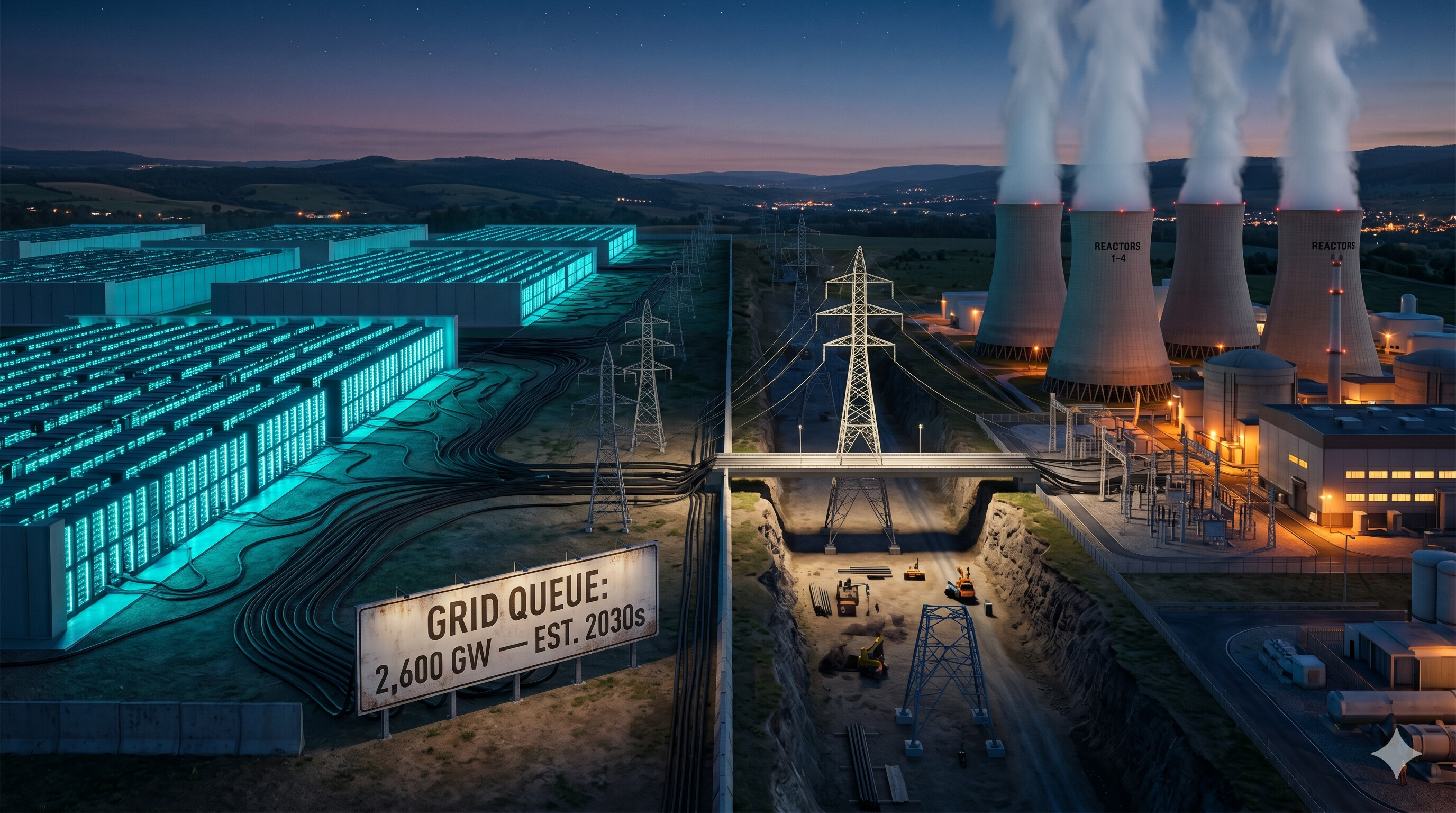
In the first half of 2026, a silent energy crisis is reshaping the geography of global AI infrastructure. Microsoft, Amazon, and Google have all signed direct nuclear power purchase agreements (PPAs) in the past six months, from restarting shuttered nuclear plants to investing in next-generation Small Modular Reactors (SMRs). The AI industry is embracing nuclear energy at an unprecedented pace.
This is not driven by environmental idealism. It is a survival strategy forced by grid bottlenecks. AI data center electricity demand is doubling every two years, but U.S. grid interconnection queues have reached 2,600 GW, with average wait times exceeding 5 years. When new solar and wind farms face interconnection timelines stretching into the 2030s, the AI industry finds itself confronting a physical constraint that cannot be bypassed.
The 1 MW Daily Reality: AI Compute Energy Hunger
Understanding the scale of this crisis requires first understanding AI infrastructure energy consumption structure.
A typical AI training cluster — for example, a supercomputer built with 100,000 NVIDIA H100 GPUs — has a peak power consumption of approximately 70-100 MW. A next-generation cluster with 500,000 Blackwell B200 GPUs could reach 300-500 MW peak power. This approaches the generation capacity of a small nuclear power plant.
More critically, AI workload power consumption patterns differ fundamentally from traditional data centers. Conventional cloud computing and web service workloads fluctuate between 30-50% utilization and can be dynamically scheduled to adapt to grid supply variations. AI training workloads, in contrast, must run at near-full capacity continuously for weeks to months. Any interruption represents massive sunk costs — a single training run interruption can waste millions of dollars in compute resources.
This means AI data centers require not just total electricity supply, but stable, uninterrupted, high-availability baseload power. This demand profile closely matches nuclear power operating characteristics.
The Interconnection Queue Crisis: 2,600 GW Bottleneck
The U.S. grid interconnection queue has become one of the most severe structural bottlenecks in the clean energy transition. According to Lawrence Berkeley National Laboratory data, by early 2026, generation and storage projects in U.S. interconnection queues exceeded 2,600 GW — more than double total U.S. installed generation capacity.
The pain point of this queue is its uncertainty. After submitting interconnection applications, developers must navigate grid impact studies, system upgrade planning, and construction phases, averaging 3-5 years, with some projects requiring 7+ years. For AI data centers needing to come online by 2027-2028, relying on the main grid to build new renewable projects is not a viable path.
This reality has driven Big Tech shift from buying green power to controlling generation assets.
Big Tech Nuclear Deals in Detail
Microsoft signed the largest corporate nuclear PPA in history with Constellation Energy in early 2026, purchasing power from the remaining operating units at Pennsylvania Three Mile Island nuclear plant to support its AI data center clusters. Simultaneously, Microsoft and NVIDIA announced a partnership to use AI to accelerate the entire nuclear project lifecycle — from design-phase parameter optimization to regulatory review documentation automation.
Amazon AWS acquired data center land near Dominion Energy nuclear plants in Virginia, planning dedicated transmission lines directly connecting to nuclear power. AWS energy strategy emphasizes geographic proximity — concentrating compute resources around existing nuclear facilities.
Google is looking further ahead to next-generation nuclear technology. The company signed the first power purchase agreement for Kairos Power small modular molten salt reactor, targeting the first SMR-powered data center by 2030. Google strategy represents a longer-term bet — if SMRs can be commercialized on schedule, they would provide modular, scalable on-site generation for data centers.
Notably, all three companies have rejected the option of simply expanding the grid. Their choices send a clear signal: in the near to medium term, AI infrastructure energy supply needs to be independent of the main grid.
The Microsoft-NVIDIA AI for Nuclear Collaboration
In March 2026, Microsoft and NVIDIA announced a strategically significant collaboration — using AI tools to accelerate nuclear project development. This targets a core problem that has long plagued the nuclear industry: project delays and cost overruns.
Nuclear projects frequently suffer delays partly due to the complexity of design and regulatory review processes. A typical nuclear project requires hundreds of thousands of pages of design documentation and regulatory submissions, each step requiring labor-intensive and time-consuming review. Microsoft and NVIDIA propose using AI to:
- Automatically optimize reactor parameters during the design phase, rapidly finding optimal solutions from millions of combinations
- Automate documentation generation and compliance checking during regulatory review
- Provide real-time progress monitoring and risk alerts through digital twins during construction
If successful, this collaboration could fundamentally change nuclear project economics. According to initial partner estimates, AI-driven design optimization and review automation could reduce nuclear project front-end timelines by 30-50%.
Global Perspective: Regional Differences in Nuclear Renaissance
The U.S. AI-nuclear pivot is the most representative case of a global nuclear renaissance, but it is not the only one.
In the UK, the government approved the Sizewell C nuclear plant while planning to quadruple nuclear capacity by 2050. UK AI data center developers are actively negotiating long-term PPAs with EDF Energy.
In Japan, NVIDIA is exploring nuclear power procurement for new data centers, leveraging reactors gradually restarting after the Fukushima accident. Japan AI strategy places particular emphasis on the energy security dimension.
In China, the situation is entirely different. China possesses both the world largest renewable energy manufacturing capacity and the fastest grid expansion rate. Chinese AI data center developers primarily rely on large-scale wind-solar bases plus storage rather than nuclear. This difference reflects structural variations in national energy infrastructure and regulatory environments.
Forward Outlook
The AI-nuclear convergence is creating a new infrastructure paradigm. Our outlook follows:
2026-2028: Existing nuclear PPA dominance. Big Tech primarily relies on existing operating nuclear plants, locking in long-term power supply through PPAs. These contracts will concentrate in the U.S. Northeast and Southeast.
2028-2032: SMR pilot projects. Kairos Power, NuScale, and TerraPower SMR projects begin powering data centers, but at limited scale. SMR commercialization progress will determine this phase velocity.
2032 and beyond: On-site nuclear becomes standard. If SMRs achieve large-scale commercialization on schedule, new large AI data centers may default to nuclear power as their baseline power solution, similar to how backup generators are standard equipment today.
The AI-driven nuclear renaissance is profoundly affecting energy policy, grid planning, and geopolitics. The AI industry hundreds of billions in annual capital expenditure is creating a massive energy demand signal, and this signal is reshaping global power industry investment direction. For investors and policymakers, understanding AI infrastructure energy demand structure has become a core variable for predicting future energy market trajectories.
Also worth watching is NVIDIA power-flexible data center concept — the company demonstration project with UK National Grid shows how AI data centers can be designed with dynamic power modulation capability, downclocking during high grid load and running full capacity during low load. If this architecture can be commercialized at scale, it may ease the rigidity of AI data center baseload power demand, though it also means AI training efficiency must adapt to electricity market fluctuations — an engineering economics problem worthy of significant research.
Disclaimer: The information provided in this article is for reference only and does not constitute investment advice or business decision-making basis. Data and time information is current as of the publication date and may change with subsequent developments. Neither the author nor POC.HK assumes any responsibility for losses resulting from the use of this information.