AI Coding Assistants Three-Way Battle: Copilot, Cursor, and Codex's 2025 Ecosystem War
By 2025, software development is inseparable from AI coding assistants. Stack Overflow's annual survey shows that 82% of professional developers report using some form of AI coding tool, compared to just 44% in 2023. But the market is not dominated by a single player — GitHub Copilot, Cursor, and OpenAI Codex are engaged in fierce competition centered around "developer experience" and "agent capabilities."
Observatory Analysis
GitHub Copilot: The Incumbent with Ecosystem Moat
Microsoft's Copilot remains the market share leader, with approximately 1.8 million paid users. Its core advantage lies in deep integration with the GitHub development workflow — from automated code review for Pull Requests to CI/CD integration with Actions, Copilot is transforming from an "autocomplete tool" into a "development lifecycle platform." The Copilot Workspace feature, launched in 2024, allows developers to describe a new feature in natural language, with AI automatically generating a complete implementation plan, code changes, and test cases.
However, Copilot also faces structural weaknesses: due to its reliance on the GitHub platform, its experience in local development environments and self-hosted scenarios is not as smooth as competitors. Additionally, its underlying model is based on OpenAI (now switched to GPT-4o), and it does not always lead in reasoning and code generation quality compared to specialized models.
Cursor: The Rise of a New Force
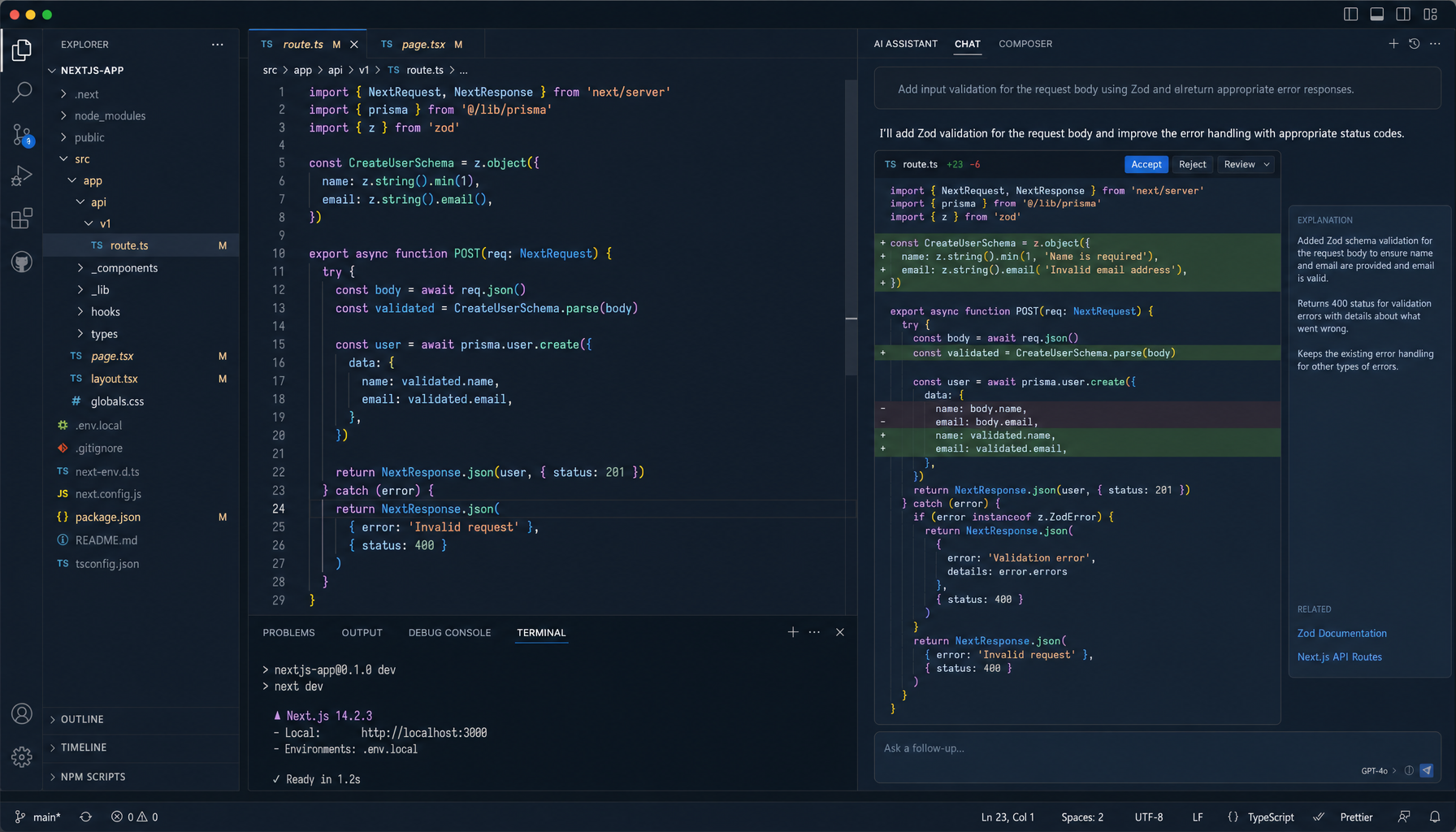
Founded by former OpenAI engineers, Cursor reached a valuation of $2.5 billion in just two years. Cursor's killer feature is "full-project context understanding" — traditional coding assistants only focus on the current file or nearby lines of code, while Cursor indexes the entire project codebase, considering cross-file structure, dependencies, and conventions when generating suggestions.
Measured performance data is impressive. On SWE-bench (which requires AI to fix real GitHub issues autonomously), Cursor's proprietary model achieves a 43% pass rate, compared to approximately 30% for standard Copilot. Cursor's "Composer" mode allows developers to simultaneously edit related code across multiple files, automatically maintaining cross-file consistency — an essential feature for large-scale refactoring projects.
OpenAI Codex: From Behind the Scenes to Center Stage
The evolution of the Codex family deserves special attention. From the original Codex (descendant of GPT-3), to code capability enhancements in GPT-4 Turbo, to the specialized o1 reasoning model, OpenAI's strategy is to make the model itself better at programming rather than improving the integration layer. o1 reached the 89th percentile human level in Codeforces competitive programming — approaching professional competitor standards.
Codex's true advantage lies in API-level diversity. Through the Assistants API, developers can build custom coding agents that integrate proprietary internal tools, documentation, and codebases. This flexibility attracts large enterprise customers — JPMorgan and Toyota are already using Codex-based internal development assistants.
Looking Ahead
Competition among AI coding assistants is evolving from "code completion" to "autonomous development." The key divide in 2025 is: who can first safely and reliably transform AI from "assistant" to "colleague"?
Agent Mode is widely recognized as the next frontier. Enabling AI not only to generate code but also to independently run tests, debug errors, consult documentation, and submit Pull Requests — this is the roadmap for all three players. Anthropic's Claude Code and Devin (developed by Cognition AI) have already demonstrated this potential.
Security and intellectual property controversies are also sharpening. Many companies have banned cloud-based coding assistants due to concerns about code leakage — Cursor responds by offering local inference modes, while Copilot has launched Enterprise editions with IP indemnification guarantees. The rise of open-source models (such as DeepSeek Coder, Code Llama) provides developers with alternatives that do not depend on any commercial service.
The ultimate winner may not be any single product. The diversity of the software development ecosystem dictates that the future will be a landscape of multiple models and tools coexisting — much like today's developers using VS Code, Vim, and JetBrains simultaneously. The real transformation is not about who monopolizes the market, but about AI lowering the barrier to software development from "professional skill" to "creative expression."