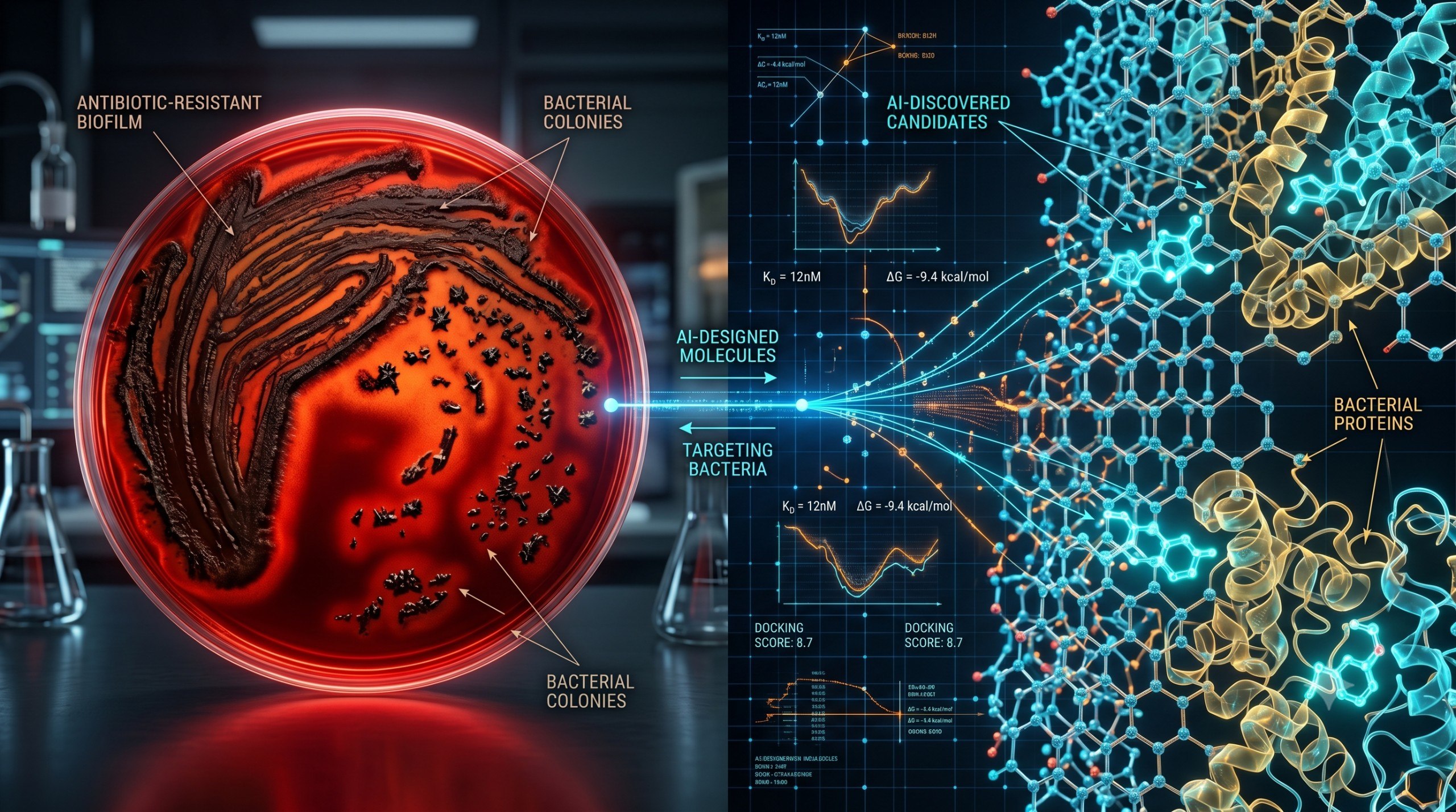
In 2019, before the COVID-19 pandemic reshaped global health priorities, antimicrobial resistance (AMR) was already ranked among the top ten global public health threats by the World Health Organization. By 2026, the situation has grown more acute: an estimated 10 million annual deaths from drug-resistant infections are projected by 2050 unless transformative action is taken — a mortality burden exceeding that of cancer. Yet in the same period, a new weapon has emerged that is fundamentally altering the trajectory of antibiotic discovery: artificial intelligence.
Traditional antibiotic discovery has been in a state of chronic decline for decades. The golden age of antibiotic development, spanning the 1940s through the 1960s, gave humanity most of the drug classes still in use today. Since then, the discovery pipeline has slowed to a trickle. Between 2017 and 2024, the World Health Organization reported that only 12 new antibiotics were approved, most of which offered limited innovation over existing classes. The fundamental problem is an economic and scientific mismatch: developing a new antibiotic costs over $1 billion and takes 10-15 years, yet the drug may be used sparingly to preserve its efficacy — a poor return on investment for traditional pharmaceutical business models.
AI is changing this calculus by compressing the discovery timeline from years to months, reducing costs by orders of magnitude, and exploring chemical space at a scale impossible for human researchers. The core insight is that antibiotic discovery is, at its foundation, a pattern recognition problem across extraordinarily high-dimensional biological and chemical data. Machine learning models can simultaneously evaluate millions of compounds against thousands of pathogen strains, identify structural motifs associated with antibacterial activity, and predict toxicity — all before a single wet-lab experiment is conducted.
THE DEEP LEARNING REVOLUTION IN ANTIMICROBIAL SCREENING
The landmark study that catalyzed the AI-antibiotic field was published by MIT researchers in Cell in 2020, where a deep neural network screened over 100 million chemical compounds and identified halicin — a molecule structurally distinct from all known antibiotics — as a potent broad-spectrum antimicrobial. Halicin showed activity against Mycobacterium tuberculosis, Clostridioides difficile, and carbapenem-resistant Enterobacteriaceae, among other priority pathogens. Crucially, the molecule was identified through computational screening alone; the model had learned to recognize patterns of molecular structure associated with bacterial growth inhibition without any prior knowledge of mechanism of action.
By 2025-2026, this approach has been dramatically scaled. Researchers at multiple institutions have developed AI platforms capable of screening virtual libraries of 1 billion or more compounds — chemical spaces so vast that no human chemist could explore even a fraction of them in a lifetime. Deep learning models trained on high-throughput screening data can now predict antimicrobial activity with accuracy that matches or exceeds conventional in vitro assays, at a fraction of the time and cost.
The structural biology dimension has also advanced significantly. AlphaFold and its successors have enabled accurate prediction of bacterial protein structures, providing AI systems with thousands of new potential drug targets. Where earlier approaches screened blindly against whole cells, modern AI platforms can design molecules de novo against specific bacterial proteins — efflux pumps, cell wall synthesis enzymes, ribosome subunits — effectively guiding the discovery process toward mechanisms that are harder for bacteria to evolve resistance against.
THE FOUR FRONTIERS OF AI ANTIBIOTIC DISCOVERY
Contemporary AI antibiotic discovery can be categorized into four methodological frontiers, each addressing a distinct bottleneck in the drug development pipeline.
First, virtual screening at unprecedented scale. Graph neural networks and transformers operating on molecular graphs can evaluate 100 million to 1 billion compounds in a single computational run, ranking them by predicted antimicrobial activity, selectivity, and drug-likeness. Companies like Insilico Medicine and Recursion Pharmaceuticals have built platforms that compress a process which traditionally takes 3-5 years of screening into 3-6 months of computation.
Second, de novo molecular generation. Generative models — including variational autoencoders, generative adversarial networks, and more recently diffusion models — can produce entirely novel molecular structures optimized for antibacterial activity. Unlike virtual screening, which selects from existing chemical libraries, generative design creates new chemistry. The implications are profound: most of the chemical space with therapeutic potential has never been synthesized or stored in any library. Generative models allow researchers to navigate this uncharted territory directly.
Third, mechanism-of-action prediction and resistance forecasting. Deep learning models can predict not just whether a compound kills bacteria, but how — identifying the specific protein target and the molecular interaction mechanism. More importantly, models can forecast the likelihood and pathway of resistance emergence by analyzing evolutionary trajectories of bacterial genomes, allowing researchers to prioritize compounds with inherently lower resistance potential.
Fourth, clinical candidate optimization. AI models now support the optimization of lead compounds through iterative cycles of molecular modification and predicted property evaluation. Bayesian optimization and reinforcement learning systems navigate the multi-parameter optimization landscape — balancing potency, selectivity, metabolic stability, solubility, and toxicity — to converge on clinical candidates with unprecedented efficiency.
FROM LAB TO CLINIC: THE PIPELINE IN 2026
The transition from computational screen to clinical candidate remains the critical bottleneck. However, 2026 marks a notable inflection point: multiple AI-discovered antibiotic candidates are now in or approaching clinical trials.
The most advanced is a novel antimicrobial compound targeting carbapenem-resistant Acinetobacter baumannii, one of the WHO's critical priority pathogens. Discovered through a deep learning screen of 7,500 compounds that was then expanded to 300 million molecules via generative expansion, the candidate showed efficacy in multiple animal infection models and is entering Phase I clinical trials in the United States. The entire discovery-to-preclinical process was completed in 18 months — compared to the typical 5-7 years for conventional discovery programs.
Another promising class involves AI-designed antimicrobial peptides (AMPs). Unlike traditional small-molecule antibiotics, AMPs target bacterial membranes through physical disruption, a mechanism to which bacteria have difficulty developing resistance. AI models have been trained to design AMPs with optimized therapeutic indices — balancing antimicrobial activity against mammalian cell toxicity. Several candidates have completed preclinical evaluation and are entering clinical testing for topical and systemic applications.
A particularly elegant approach involves using machine learning to "resurrect" obsolete antibiotics by modifying their molecular structures to overcome existing resistance mechanisms. By training models on structural data of antibiotic-inactivating enzymes (beta-lactamases, aminoglycoside-modifying enzymes), researchers can predict which modifications to existing antibiotic scaffolds will evade degradation. This approach has yielded several promising candidates targeting ESBL-producing and carbapenemase-producing Enterobacteriaceae, addressing some of the most urgent clinical needs.
THE ECONOMICS OF AI-DRIVEN DISCOVERY
The economic transformation of antibiotic R&D under AI is as significant as the scientific one. Traditional antibiotic discovery carries an average cost of $1.3 billion per approved drug, with failure rates exceeding 95% between preclinical discovery and regulatory approval. AI-driven platforms reduce this cost structure at multiple points.
Computational screening eliminates the need for physical compound libraries and reduces the number of wet-lab experiments by 90-99%. Generative models allow researchers to explore chemistry that would cost millions to synthesize and test in vitro. Toxicity prediction models reduce late-stage attrition — the single largest cost driver in drug development. Overall, AI-driven discovery platforms claim to reduce preclinical discovery costs by 50-80% and compress timelines by 60-70%.
However, the economic sustainability of antibiotic development faces a deeper structural challenge: the misalignment between public health needs and market incentives. Antibiotics, unlike chronic disease therapeutics, are typically administered for days or weeks rather than years. Reimbursement models that work for oncology or cardiology do not apply. The antibiotics market is structurally broken — multiple biotech companies that successfully developed novel antibiotics have filed for bankruptcy because they could not generate sufficient revenue to sustain operations.
AI can accelerate discovery, but it cannot fix the market failure. Policy interventions — including the PASTEUR Act (pending US legislation that would create a subscription model for novel antibiotics) and the UK's NHS subscription model — are essential complements to the technical progress AI enables. The Observatory notes that without parallel economic reform, the AI-driven discovery pipeline risks producing a new generation of antibiotics that never reach patients.
OUTLOOK: THE NEXT DECADE OF AI-ANTIMICROBIAL RESEARCH
Looking ahead to 2030, several structural shifts are visible. First, the integration of AI with synthetic biology — using machine learning to design and optimize engineered biosynthetic pathways — will enable the discovery of entirely new antibiotic classes from microbial natural products, revisiting the soil-derived discovery model that produced the first antibiotics, but with computational guidance. Second, real-time resistance monitoring using genomic surveillance data, combined with AI predictive models, will enable precision antibiotic deployment — matching the right drug to the right infection at the right time, reducing selection pressure for resistance. Third, AI-designed combination therapies — antibiotic pairs or triples designed from the ground up to suppress resistance emergence — will move from computational prediction into clinical validation.
The antimicrobial resistance crisis is not a future threat but a present emergency. AI offers the most promising technical path forward since the discovery of penicillin. But technology alone is insufficient. The Observatory's assessment is that the transition from AI-discovered molecules to clinically deployed antibiotics will depend as much on economic reform and regulatory innovation as on algorithmic advances. The window for action is narrowing: by 2030, projections suggest that 30% of all bacterial infections in some regions will be pan-drug resistant. The race between AI and evolution has begun.
免責聲明:本文所載資料僅供參考,不構成任何投資建議或商業決策依據。數據及時間資訊以發布當日為準,可能隨後續發展而有所變動。作者及POC.HK不對因使用本文資訊而導致的任何損失承擔責任。