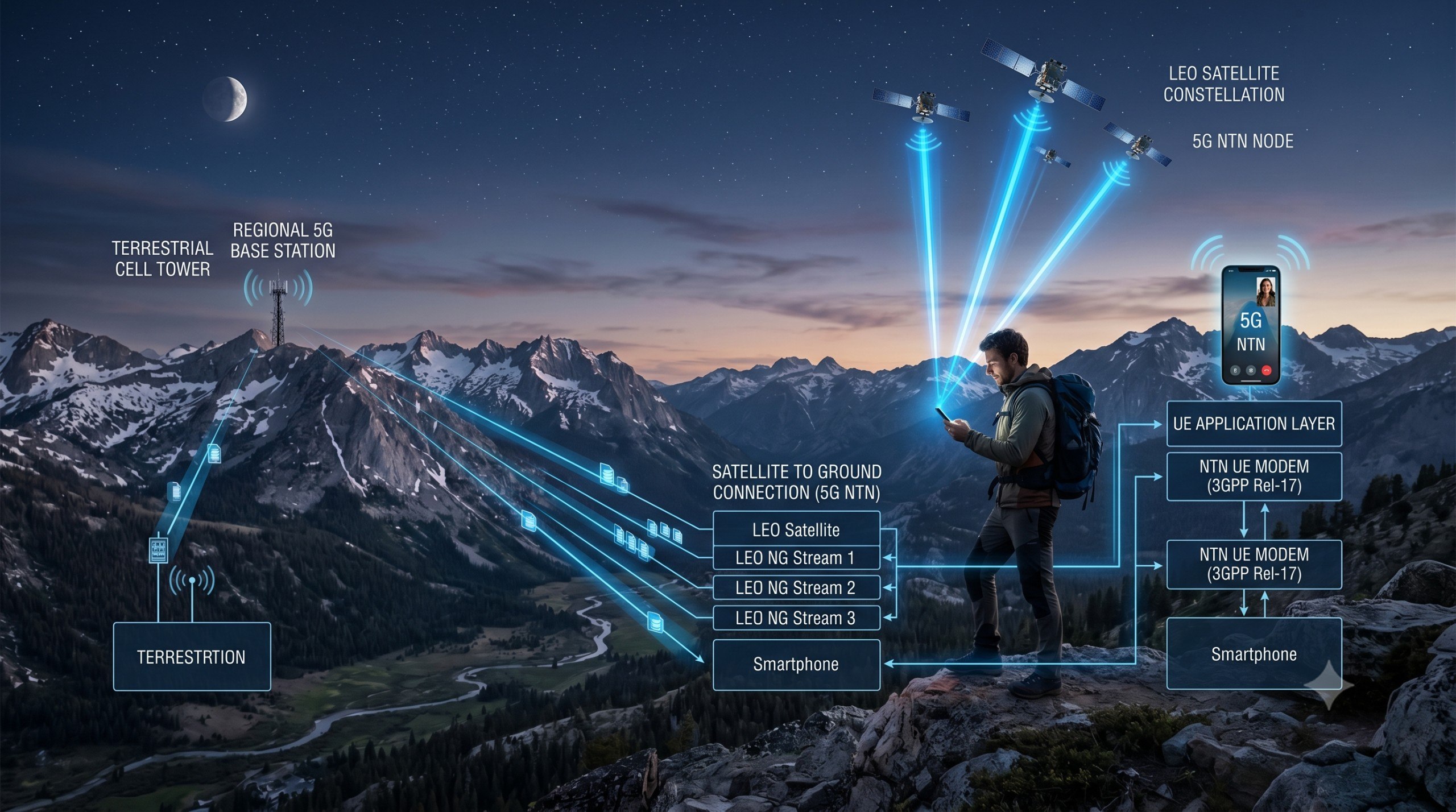
The convergence of 5G telecommunications networks and satellite infrastructure has reached a critical inflection point in 2026. Non-Terrestrial Networks — the 3GPP standardised framework for integrating satellites into the 5G ecosystem — have moved from standards documents and laboratory demonstrations to commercial deployment, with MediaTek's MT6825 becoming the world's first commercially available 5G NTN chipset and operators like Gilat demonstrating end-to-end 5G NTN connectivity over GEO satellite infrastructure.
This convergence represents more than an incremental improvement in connectivity. It fundamentally rewrites the relationship between terrestrial mobile networks and space-based infrastructure, transforming satellites from specialised communications tools for niche users into an integral part of the global mobile network fabric — accessible from any standard smartphone without specialised hardware.
The 3GPP NTN Framework
The 3GPP, the standards body responsible for global mobile telecommunications specifications, has defined NTN in two tracks. NTN-IoT (Release 17) focuses on low-bandwidth, narrowband IoT connectivity over satellite links, enabling asset tracking, environmental monitoring, and emergency messaging from any location on Earth. NTN-NR (Release 18 and beyond) targets full 5G New Radio connectivity over satellite, enabling voice, video, and broadband data services directly to standard smartphones.
NTN-IoT has already entered commercial service, operating primarily over geostationary orbit constellations. MediaTek's MT6825 chipset, announced in 2025, is the first commercially available 5G NTN NB-IoT chipset, capable of connecting to GEO satellite constellations compliant with 3GPP NTN standards. The chipset allows devices to automatically receive satellite messages — unlike competing solutions that require users to manually check for messages — and offers power efficiency designed to extend device battery life for years of unattended operation.
NTN-NR, the higher-bandwidth track, is where the truly transformative potential lies. Rather than requiring dedicated satellite phones, NTN-NR will allow any 5G smartphone to connect directly to LEO satellites for voice calls, messaging, and eventually broadband data. This requires significant advances in satellite antenna technology and signal processing to compensate for the 600 km path loss and doppler shift inherent in LEO communications, but the economic prize — connecting the roughly 3 billion people who remain outside terrestrial 5G coverage — is enormous.
Gilat's 5G NTN End-to-End Demonstration
In a significant proof point, Gilat Satellite Networks demonstrated end-to-end 5G NTN services over existing GEO satellite infrastructure in early 2026. The demonstration validated that standardised 5G NTN technology can deliver high-performance connectivity through satellites that are already in orbit, without requiring new dedicated satellite launches.
This is strategically important. The ability to deliver 5G NTN services over existing GEO infrastructure means that the technology can be deployed immediately, without waiting for the deployment of dedicated NTN satellite constellations. Operators can begin offering 5G satellite services using their current fleet while planning next-generation LEO constellations optimised for NTN-NR.
The Gilat demonstration covered multiple scenarios: enterprise connectivity for remote sites, mobility services for aviation and maritime, and broadband access for underserved communities. The company's SkyEdge IV platform, the next-generation multi-orbit satellite networking platform, provides an evolution path from current services to full 5G NTN.
The Economics of Convergence
The market projections are striking. Research firm MarketsandMarkets estimates the 5G from Space market will grow from 00 million in 2023 to .7 billion by 2028, a compound annual growth rate of 65.1%. This growth is driven by the development of new applications and services that were previously impossible without ubiquitous connectivity — autonomous vehicle teleoperation, precision agriculture, remote industrial control, and universal emergency communications.
The economic logic of NTN convergence is straightforward. Terrestrial 5G networks are capital-intensive to deploy, with each base station covering a limited geographic area. In densely populated urban areas, the economics work: millions of subscribers per square kilometre justify the infrastructure investment. But in rural, maritime, and remote areas, the subscriber density cannot support terrestrial deployment costs. Satellite connectivity fills this gap, extending 5G coverage to the roughly 80% of the Earth's land surface that lacks any terrestrial mobile coverage.
Observatory Analysis
The 5G NTN convergence represents a structural shift in how we think about network infrastructure. For the past three decades, telecommunications and space have operated in separate domains — terrestrial networks handling mass-market connectivity, satellites providing specialised services for maritime, aviation, and remote applications. NTN collapses this distinction, making satellites a seamless extension of the 5G radio access network.
The implications extend beyond consumer connectivity. NTN creates the communications infrastructure required for autonomous systems to operate globally — ships, aircraft, trucks, and agricultural equipment that must maintain connectivity beyond the reach of terrestrial networks. It also provides a backup path for critical infrastructure during terrestrial network outages, an increasingly important consideration as cyberattacks and natural disasters test network resilience.
However, the regulatory landscape remains fragmented. The FCC's supplemental coverage from space framework, adopted in 2024, has influenced regulators in Canada, Europe, Africa, and Asia, but the patchwork of national spectrum allocations and licensing regimes creates friction for truly global NTN services. The industry's ability to navigate this regulatory fragmentation — not just the technical challenges — will determine how quickly the vision of ubiquitous 5G satellite connectivity becomes a commercial reality.
The most significant competition in this space is not between individual satellite operators but between technological approaches: dedicated NTN satellites versus terrestrial 5G towers with satellite backhaul, LEO constellations versus GEO-based services, and 3GPP-standardised NTN versus the proprietary direct-to-cell solutions being deployed by SpaceX's Starlink and AST SpaceMobile. The winner of this standards battle will define the architecture of global connectivity for the next decade.
Disclaimer: The information contained in this article is for reference purposes only and does not constitute investment advice or any form of commercial decision-making basis. Data and time-sensitive information are accurate as of the date of publication and may change with subsequent developments. The author and POC.HK assume no responsibility for any losses arising from the use of the information herein.